Showing posts with label curry. Show all posts

Friday, June 6, 2014

Raghavan Iyer's Chicken Simmered in a Coconut Milk-Vinegar Sauce from 660 Curries

Here's another chicken curry for ya'll (no, I'm not from the South) to try!  This was a last minute sort-a curry, but I can't really remember how I landed on it (there's so many to choose from!) ... my thought process probably went something like this

Chicken doesn't need to be marinated? ... check. 
Do I have all the ingredients listed? ... check.  
Simple process?... check.  
Done!  

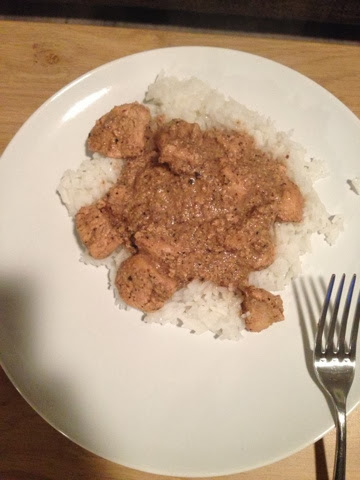
As you can see in the first photo, this is a vindaloo... which equals spicy, but in my opinion the coconut milk significantly cuts down the heat.  You can still make this recipe and tailor it for your tolerance level, but if you're not into spicy food, I'd recommend trying another chicken curries with more flavor (check out some of my past posts!).  

So, here's the recipe: 

Chicken Simmered in a Coconut Milk-Vinegar Sauce


Ingredients: 

As I have now cooked a significant number of curries from this cook book, I prefer a higher ratio of curry (sauce) to chicken.  I have tailored my recipe accordingly.  
  • 2 tablespoons of oil (I used coconut oil, recipe calls for canola)
  • 1 medium sized red onion, cut in half lengthwise and thinly sliced
  • 300 grams of chicken breast cut up into approximately 1 inch cubes
  • 1/4 cup distilled white vinegar (I didn't have enough vinegar so I used up what I had and filled the remainder with cider vinegar per the suggestion in the book)
  • a couple cloves of garlic minced
  • 1 tablespoon of coriander seeds, ground (freshly ground is best)
  • 2 teaspoons of cumin seeds, ground (freshly ground is best)
  • 1 teaspoon cayenne pepper
  • 1/4 teaspoon cayenne pepper mixed with 3/4 teaspoon of sweet paprika (the recipe calls for 1 teaspoon of ground Kashmiri chiles, but since I don't have this I used the replacement)
  • 1 teaspoon of sea salt
  • 1/4 teaspoon ground turmeric
  • 1 cup unsweetened coconut milk
Directions: 
  1. Heat the oil in a large skillet over medium-high heat.  Once warm, add the onion and cook until light brown until light brown around the edges (stir so they don't burn), about 3-5 minutes. 
  2. Lower the heat to medium and add the chicken pieces.  Cook until they have browned, about 2-3 minutes per side.  Transfer the chick and onion to a plate. 
  3. Pour the vinegar into the skillet and add the minced garlic, ground coriander, ground cumin, cayenne, Kashmiri chiles (or replacement), salt and turmeric.  Scrape the bottom of the skillet to deglaze.  Reduce the heat to medium-low, cover, and simmer the sauce, stirring occasionally until some of the oil starts to separate around the edges of the skillet and on the surface.  
  4. Stir in the coconut milk, and return the chicken to the skillet.  Cook, covered stirring occasionally, until the meat in the thickest parts of the chicken is no longer pink inside and the juices run clear, about 18 to 20 minutes.  Cook longer if desired to thicken the sauce (note the original recipe calls to remove the chicken and then thicken the curry  separately... I chose not to do this for the sake of time and convenience!).  
  • Raghavan mentions that cider or malt vinegar can be used instead of white wine vinegar for a sweeter tasting sauce.  As I mentioned above, I used cider vinegar out of necessity.  I didn't detect much sweetness, so it's subtle at most.  


Note, I served with rice, as is pretty much always standard for me.  You could certainly serve with naan or roti, but I find the rice soaks up the curry best, also cutting a bit of the heat.  

Hope you enjoy this curry!


Wednesday, June 4, 2014

Raghavan Iyer's Green Mangoes with a Yogurt-Toasted Coconut Sauce from 660 Curries

Gah!  I know it's been over 2 months since I last posted.  My computer died and for a while we thought it was completely kaput, but it turns out some love at the (look-alike) Apple store did it some good ... so now we're up and running and I have a lot of backlog topics I really want to share with you all... so bare with me as I get through it all. 

Last weekend, my husband bought mangoes at the fresh market in Wonsel and while one of them was this delicious, juicy, sweet mango.... the other, unfortunately and disappointingly (!) was not ripe enough.  In seeing that it wasn't ready for eating, I quickly consulted my good old Indian curry cook book, 660 curries... thinking if I was going to find a mango curry, it would only be there!  I was in luck, as you can see from the photo below, and this dish was soooooo delicious!  The combination of the tart and sweet mango with the savory and nutty taste of the coconut flakes and coconut milk were an awesome combination!  There was a lot of heat in this dish which contrasted to the sweetness of the mango and the creaminess of the coconut milk well.  DELISH!

So, here's the recipe: 

Green Mangoes with a Yogurt-Toasted Coconut Sauce


Ingredients: 
  • 2 large green (unripe) mangoes, peeled, seeded, and cut into 1/2 inch cubes (I used 1 green mango, because that's what was available to me and it was slightly ripened... i.e. the flesh had some sweetness, but you wouldn't have found it very good to eat plain)
  • 1 teaspoon sea salt
  • 1/4 teaspoon ground turmeric
  • 2 tablespoons canola oil (I used coconut oil)
  • 1 cup shredded fresh coconut (I used coconut flakes, the were not fresh, but they weren't dried such that they needed to be reconstituted - they are for snacking, but you know.... )
  • 1 tablespoon yellow split peas
  • 1 teaspoon whole black peppercorn
  • 1 or 2 fresh green thai chilies (or whatever type of spicy chili you have available, add to your taste level) 
  • 1 or 2 dried Thai chilies (or whatever type of spicy chili you have available, add to your taste level; I used Italian pepporncini since that's what we currently have in the house!)
  • 1 tablespoon crumbled (or chopped) jaggery or firmly packed dark brown sugar (I used brown sugar)
  • 1/2 cup thick yogurt (I used greek yogurt)
  • 1/2 teaspoon black or yellow mustard seeds (I used black, for no particular reason as I have both)
  • 1/4 teaspoon fenugreek seeds

Directions: 
  1. Combine the mangoes, salt turmeric, and 3 cups of water in a medium-size saucepan and bring to a boil over medium heat.  Continue to boil, uncovered, stirring occasionally, until the mangoes are tender but still firm looking, about 8 to 10 minutes. 
  2. In the meanwhile, heat 1 tablespoon of the oil in a medium-sized skillet over medium-high heat.  Add the coconut, split peas, peppercorns, and the fresh and dried chilies, and stir-fry until the coconut is toasted (brown colored), and the chilies are blistered slightly.  Approximately 5 minutes. 
  3. Drain the mangoes reserving 1 cup of the yellow broth they cooked in. 
  4. Pour 1/2 cup of the reserved mango broth into the coconut mixture and scrape the bottom of the skillet to deglaze it, releasing any browned bits of coconut.  Transfer the mixture to a blender jar and puree until a gritty like past speckled with spices. 
  5. Return the drained mangoes to the same saucepan thy cooked in, and add the coconut paste (I used a plastic spatula - typically used for baking - to get all of the paste out of the jar).  Pour the remaining 1/2 cup of reserved broth into the skillet. Add the brown sugar and stir in.  Cook the mixture over medium heat, uncovered, stirring occasionally (until the jaggery dissolves, if using).  Remove the pan from the heat and stir in the yogurt. 
  6. Heat the remaining 1 tablespoon of oil in a small skillet over medium high heat.  Once warm, add mustard seeds and cover quickly.  Allow the mustard seeds to stop popping and then add the fenugreek seeds.  The fenugreek seeds will quickly brown and emit a nutty smell.  Remove from heat and pour over the curry.  Stir to combine and serve! 

I looked in the book for a recommendation of what to serve this curry with and didn't find anything.  I ended up choosing white rice, which worked out really well as it mopped up the curry pretty well without changing the taste of it! 


Hope you try it!  Happy curry-ing!

Friday, March 28, 2014

Chicken with Almond Yogurt Sauce (Chicken Korma) from 660 Curries

Update: March 28, 2014

I remade this recipe after I went out and bought blanched almonds.  I also took more time blending (I used an immersion blender as you can see from the photo below) the 'curry' through so there weren't large chunks of almond.  The immersion worked well to blend through the whole spices (peppercorn, cardamom, etc.) as long as I gave the mixture time to blend together.  I think this recipe turned out a lot better, packed with flavor and not weighted down from the skins of the almonds.  

You can blanch your own almonds by soaking them in room temperature water overnight and peeling the skins the next day.  Alternatively you can buy them and if you don't have a powerful blender, consider buying them slivered, this will help immensely!  

I used cut cub chicken breast again instead of a whole breasts. I used cinnamon powder (which I bought at our local Persian store and which is very strong) instead of cinnamon stick since I needed to use it up.  I used green cardamom pods instead of white (I don't find a flavor difference here, I think it's used for appearances as in if you were going to use cardamom powder in a cake or frosting... anyone out there know?). 

Blending the curry.  Used the immersion blender and blended for a good 5-8 minutes to make sure everything was blended together and evenly.  Whole spices were blended in this mixture as well. 
Chicken curry cooking, with reduced sauce.  Very mud-like.

Dinner is served (over white rice)

Enjoy!
_____________________________________________________________

Original Post:

Trying to get back onto the bandwagon of posting food recipes.... so here goes my first food posting of the year! 

While this was not my favorite curry recipe from 660 Curries by Raghavan Iyer, it's nevertheless worth a post since it's an interesting dish.  It happened that the next day, as I was reading, Curry: A tale of cooks and conquerors by Lizzie Collingham, I also learned a little about its origins and how the curry became as it is today.  According to this book, Indian cooking was heavily influenced by Persian cooking techniques.  For korma, the concept of marinating the meat in yogurt with spices (the first step of this recipe) was a Persian one.  The Mughals ('kings' ruling regions of India) brought food influenced by Persia and central Asia added spice to the marinade/dish.  The Mughals would not have used chilies, but as chilies made their way from South India to North India, they eventually were incorporated (chilies originated from the Portuguese who brought them to Goa, India... fascinating stuff!).  The chefs of Lucknow (another region in India), added cream to everything which was also eventually incorporated into this dish.  In this case, the marinade in the form of yogurt, but in other cases, actual heavy cream is used to thicken the curry.  In this particular dish, ground almonds is used to thicken the cream, which is also a Persian influence.  

I love that I'm getting  dose of history as I make these curries, it makes it so much more fun to cook.  

Ingredients: 

1/4 cup yogurt (I used greek yogurt)
1 thumb sized piece of ginger, minced (recipe calls for 2 tablespoons of ginger paste which is a lot of ginger and water ground together than can be stored in your fridge for use whenever... I don't do this)
3 cloves of garlic minced (1 tablespoon of garlic paste - same as above) 
1 kilo (2.2 pounds) of chicken breast (recipe calls for 3.5 pounds) cut into cubes
2 tablespoons of olive oil (recipe calls for canola oil)
1/2 teaspoon of whole cloves
1/2 teaspoon of black peppercorns 
6 green or white cardamom pods (I used white)
3 black cardamom pods (I bought these at Penzeys)
3 cinnamon sticks (each 3 inches long)
2 fresh or dried bay leaves (I used dry)
1 medium sized red onion, cut in half lengthwise and thinly sliced
1/2 cup of slivered blanched almonds (I did not blanch them, next time I would try this)
1.5 teaspoons cayenne pepper 
Fresh cilantro chopped for garnish

Directions: 
  1. Blend together the yogurt, ginger and garlic (use a small amount of water if you find it too thick or regular yogurt as opposed to greek yogurt which is very thick) in your blender or a small bowl.  Cover the chicken pieces with the yogurt blend and refrigerate, covered overnight (you could also do this for a shorter amount of time, ~ 1 hour if you are limited on time) to marinate the chicken.  
  2. Heat the oil in a large skillet over medium-high heat.  Add the cloves, peppercorns, green/white and black cardamom pods, cinnamon sticks, and bay leaves.  Cook until they sizzle and smell aromatic (~recipe calls for 1-2 minutes).  Do not let the spices burn. 
  3. Add the onion and cook until they are light brown, about 5 minutes.  Transfer the onion and all the spices to your blender jar and port in 1 cup of water.  Add the almonds, salt, and cayenne.  Puree until blended together forming a gritty solution, not quite paste-like, but it could be if less water was present. 
  4. Place the chicken including any marinade in the skillet and cook over medium-high heat.  I find that there ends up being too much water so I use a paper towel to soak up the water. Cook until the chicken is browned. 
  5. Add the onion paste to the skillet.  Pour 1/4 cur pot water into the blender jar and wash out the remaining almond solution.  Cover the chicken in the curry completely, make sure all pieces are covered.  Once it starts to bubble (like mud!), reduce the heat to medium-low and cover the skillet.  Occasionally stir the mixture ensuring all chicken pieces are cooked evenly.  Cook until the chicken is fully cooked (which I check by taking out a thicker piece and cutting it at the thickest portion to see if the inside is white). 
  6. Sprinkle the cilantro over the curry for garnish.  Serve with rice. 


To be totally honest, while the curry has lots of flavor and included new spices (white cardamom) and techniques (ground almonds to make a thick curry), the dish was not novel to my palate.  I do want to re-try this recipe with blanched almonds (without the almond skin), I think this could lighten up the curry a little.  Perhaps a fresh squeeze of lemon would give it some brightness, but then it might change the flavor profile altogether.  

Regardless, I wanted to post this recipe as I think it could be fun for those willing to try.  If you do, let me know how it goes! 

Happy Currying! 

Tuesday, March 4, 2014

Raghavan Iyer's Chicken with Yellow Split Peaks (Murghi Dalcha) from 660 Curries

This weekend, I was flipping through 660 curries, trying to find a chicken curry that uses curry leaves....  yes, I stock curry leaves as a regular ingredient in my home thanks to the local Asian store that always has a decent supply of them.  To my surprise, it was more difficult than I thought, but I found a couple of recipes.  Both are similar in that they both include yellow/orange lentils, but the recipe I chose used cooked lentils (instead of roasted and ground up with other species) and didn't require marinating the chicken (which is only something I can manage on the weekends).  I'll definitely have to give the other recipe a try because my experience of using lentils (especially yellow lentils) as part of the spice mix is superb! 

Curry leaves have a unique flavor and scent that cannot be replaced with other spices or dried curry leaves.  According the website included in this caption, curry leaves can be frozen and do not need to be thawed before using.  Your local Asian or Indian store should carry fresh curry leaves.  Image taken from http://www.chow.com/food-news/137167/what-are-curry-leaves/. 
While this was a new curry cooking technique, it tasted a lot like 'dal' (Indian lentil soup) to me.  I thought the chicken was a lost component, but I realized afterwards that the recipe calls for bone-in chicken, almost 2 pounds of it, and I had used chicken breast that was cut into 1 inch cubes.  I think the chicken bones would definitely added some flavor that was missing in my version, and as a result of the longer cooking time, the cinnamon sticks would have likely released more flavor too.  My husband did not have the same reaction I did, he enjoyed the savory flavor of this dish and especially liked the mustard seed/curry leaf flavors, at topping added as a finish touch. 


Ingredients:
(While the ingredients list might seem long, if you typically cook Indian food, you will have most of these ingredients on hand anyway.  If not, visit your local Indian store.)
  • 1 cup yellow split peas
  • 1 teaspoon of tamarind paste or concentrate (I recommend you get the seedless kind if you can)
  • 1 small red onion, coarsely chopped
  • 3 cloves of garlic
  • 2 inch length 'knob' of ginger
  • 4 fresh green Thai chilies, stems removed
  • 4 tablespoons of oil (recipe calls for canola oil, I used coconut oil)
  • 1 teaspoon of cumin seeds
  • 3 dried bay leaves (you could also use fresh ones)
  • 2 cinnamon sticks 
  • 2 pounds cut-up bone-in chicken, skin removed (I used 300 grams of 1 inch cubes of chicken breast, even though I used far less chicken then what the recipe called for I thought this was a good amount of soupy stuff [curry] to chicken) 
  • 2 teaspoons sea salt
  • 1/4 teaspoon ground turmeric
  • 2 tablespoons finely chopped cilantro 
  • 1 teaspoon black or yellow mustard seeds
  • ~30 small curry leaves (or 12 to 15 small to medium sized curry leaves)
Directions:  
  1. Wash the split peas with cold water until the water runs mostly clear (this may take 3-4 rinses).
  2. Add 3 cups of water to the pan and bring split peas and water to a boil, uncovered, over medium-high heat.  
  3. Skim off and discard any foam that forms on top. 
  4. Lower the heat to medium and simmer, uncovered, stirring occasionally until split peas are partially cooked, about 5 -8 minutes. 
  5. Stir in the tamarind paste, making sure it dissolves. 
  6. While the split peas are cooking, combine the onion, garlic, ginger, and chilies in a food processor and process until minced. 
  7. Heat 2 tablespoons of oil in a large skillet over medium-high heat. Add cumin seeds, bay leaves, and cinnamon sticks to the hot oil and cook until they sizzle and smell aromatic, 10 to 15 seconds.  Add the onion-chilie blend and stir fry until the onion turns brownish, 3 to 5 minutes. 
  8. Add the chicken pieces (meat side down if you are using bone-in pieces) on top of the cooked onion mixture.  Cook until the chicken turns light brown, 2 to 4 minutes.  
  9. Sprinkle in salt and turmeric.  
  10. Pour in the split peas with their cooking water, and stir once or twice. Heat to a boil and then reduce to medium-low, cover and simmer, stirring occasionally until meat is cooked. About 15 to 20 minutes if using 300 grams of 1 inch pieces of chicken breast, about 40 to 45 minutes if using 2 pounds of bone-in chicken. 
  11. Heat remaining 2 tablespoons of oil in small skillet over medium high heat. 
  12. Once the oil is hot, add the mustard seeds.  They will begin popping immediately, allow them to pop (about 30 seconds). 
  13. Remove skillet from heat, and add curry leaves - they will spatter (especially if freshly washed!), so use your oil splatter cover.  
  14. Pour the mustard-curry leave mixture in the curry and stir once or twice. 
  15. Serve over white rice. 


Tuesday, February 25, 2014

Raghavan Iyer's Lamb Biryani from 660 Curries


Recently, the local Persian grocery store butcher has been stocking the meat case with lamb shank (or what we think is lamb shank - speaking in English is iffy and we don't speak enough Dutch to converse adequately).  Given that lamb is pretty expensive or not stocked at other butchers or the standard grocery store, we've been taking advantage of their supply as much as possible.  I often use lamb in a Persian soup which serves as our lunch, but this week I decided to also explore the lamb curries of Raghavan Iyer's 660 Curries.  While this isn't a 'curry' as many people understand curry, it's a wonderful mix of meat, herbs, spices, rice, and sometimes nuts and raisins. According to Raghavan, this biryani is originates from Hyderabad and is called 'kacchi biryani' where 'kacchi' is uncooked lamb (which is later layered with cooked rice and then baked).  

I've previously made chicken biryani's (although I realize I've never posted about them on this blog!), but this is a different twist with a completely different flavor from the meat.  

Ingredients: 

For the Lamb Marinade:
  • ~ 1 lb (I used 10 oz) lamb of leg, cut from the bone (if not already available this way), fat trimmed and cut into 1 inch cubes
  • 1 cup of plain yogurt (I prefer Greek yogurt, but otherwise use full fat yogurt)
  • 1/2 cup of firmly packed mint leaves, finely chopped
  • 1/4 cup of firmly packed cilantro, finely chopped
  • 2 tablespoons of minced ginger
  • 1 tablespoon of minced garlic
  • 1-2 Thai chilies (original recipe calls for Kashmiri chilies, which I have replaced with Thai chilies)
  • 1.5 teaspoons of sea salt
  • 1 teaspoon of garam masala (I used a pre-made mix)
  • 1/2 teaspoon of ground turmeric
For the rice: 
  • 1 cup of white/brown basmati rice
  • 2 tablespoons of coconut oil (original recipe calls for Ghee or unsalted butter)
  • 1 teaspoon cumin seeds
  • 2 black cardamom pods
  • 2 free or dried bay leaves (I used dried)
  • 2 cinnamon sticks
  • 1 small red onion, thinly sliced
  • 1/2 teaspoon saffron threads
  • 1 teaspoon of sea salt
Others: 
  • 2 tablespoons coconut oil (original recipe calls for Ghee or unsalted butter)
  • 2 tablespoons of finely chopped mint for garnish
Directions: 

Position the rack in the center of the oven and preheat to 350F (~175C).
  1. Marinate the lamb (min 3 hours, overnight if possible): Combine the lamb, yogurt, mint, cilantro, ginger, garlic, chilies, salt, garam masala, and turmeric in a bowl and toss/stir to completely coat the lamb.  Refrigerate, covered overnight (or at least 3 hours before cooking). 
  2. Soak the rice (min 1 hour, longer for brown rice): Depending upon if you are using white or brown rice, before you are ready to start assembling the biryani, prepare the rice:  Rinse the rice until the water runs clear (first two rinses will be cloudy).  Fill the bowl half way with cold water and let it sit at room temperature until the grains soften.  One hour is sufficient for white rice.  I soaked for 3 hours for brown rice (note, I did not experiment with the time - seek advice on the back of your packaging for advice or elsewhere). 
  3. Cook the rice: 
    1. Heat coconut oil/ghee/unsalted butter in a medium sized saucepan over medium high heat.  Add cumin seeds, cardamom pods, bay leaves, and cinnamon sticks.  Cook until they sizzle, about 3 to 5 minutes (note, original recipe calls for 15 to 20 minutes, but on medium-high heat, this doesn't take long for me... if I let them go longer, the cumin seeds will burn).  Then immediately add the onion and stir-fry until the onion is light brown around the edges, about 10 minutes (note, original recipe calls for 3 to 5 minutes, for browning on the edges, I think it needs longer).  
    2. Stir in the saffron and allow the mixture to release its fragrance.  Add the drained rice and toss gently to coat the grains with the mixture.  Pour 1 cup of cold water, add the salt, and stir the rice to incorporate the ingredients.  Bring to a boil over medium-high heat. Cook until the water has just evaporated and remove from the heat.  For brown rice, consider adding another 1/2 cup of water as this type takes longer to cook through.  
  4. Assemble the Biryani and Bake: 
    1. Lightly spray the interior of a medium sized casserole dish with cooking spray or coat with melted ghee/butter/coconut oil.  
    2. Spread the lamb (including any remaining marinade) across the bottom and drizzle melted ghee/coconut oil/butter.  
    3. Add the rice mixture, spreading evenly over the lamb. 
    4. Cover the casserole dish and bake until the rice is cooked through and the lamb is fork-tender (approximately 1 hour).  
  5. Serve: Garnish with finely chopped mint and serve.  Note, there are whole spices in this dish, so be careful to eat around these.  


What biryani's have you made?  Have you ever baked one (this was my first baked biryani)?  Any cooking tips?

Monday, October 28, 2013

Raghavan Iyer's Sliced Okra Soup (bathed in Buttermilk) from 660 Curries

I'm finally back in the kitchen, inspired by local ingredients and fellow friends helping me get back into the groove of things.  I'm definitely working my way back up the hill, but things are looking up.  This weekend was fantastic cooking-wise, I managed to get a number of recipes under my belt that I'm happy to be writing about.  I think I spent both Saturday and Sunday in the kitchen for a minimum of four hours each, but I am slowly beginning to feel normal in the kitchen again.

This recipe was one I decided on last minute on Saturday to accompany some roasted lamp chops I threw together (roasted in our brand new oven, more to come on that!) for dinner.  While I'm not sure it was the greatest pairing in the world, this was a delicious soup and fabulously simple to prepare and cook that I am inclined to make this a standard go-to 'open friends eyes to Indian food' recipe!

Note, I didn't plan well enough in advance to have buttermilk on hand.  Upon researching via the internet, I did find that a common replacement is one tablespoon of lemon juice for every cup of milk. Based on my research, the amount of time you should let the mixture sit is non-standard, I read anywhere between 2 and 10 minutes.  I ended up going with about 5 minutes, for good measure. Admittedly I have no idea what this recipe tastes like when buttermilk is used, but if you're looking for an healthy alternative, milk with lemon juice is a good one!

Ingredients:
1 pound okra (I used a frozen bag since good, fresh okra is available here.  These will little mini-okra which were cute, tasted the same as long okra)
4 cups buttermilk (or as per above, I used 1 tablespoon of lemon juice for every cup of milk, let the mixture stand for about 5 minutes before using)
2 tablespoons of chickpea flour (also called Besan in Hindi, can be found in any Indian grocery store or perhaps try a Whole Foods type of store)
2 tablespoons white granulated sugar
2 teaspoons of salt
2 teaspoons of cayenne pepper
1/4 teaspoon of ground tumeric
2 tablespoons of finely chopped fresh cilantro leaves and stems (remove bulky stems)
12 medium-sized to large fresh curry leaves (as Raghavan advises in his book, there is no replacement for these leaves, if you don't have them just omit them.  Usually found in any Indian grocery store.  I only had dried leaves available when I made this soup)
2 tablespoons Ghee or melted butter
1 teaspoon cumin seeds
1 teaspoon fennel seeds (I just realized this recipe calls for fenugreek seeds and I used fennel, I will have to try this again!)


  1. Trim the caps off the okra, and then cut the pods into 1 inch lengths.  Cut the pieces length wise.
  2. Whisk the buttermilk/milk, chickpea flour, sugar, salt, cayenne, and turmeric together in a bowl, making sure the flour is completely incorporated with no lumps.  Then stir in the cilantro and curry leaves.                                        
  3. Heat the ghee or melted butter in a large saucepan over medium-high heat.  Sprinkle the cumin and fennel seeds into the pan and cook until they sizzle, turn brown-ish, and are fragrant, about 10 seconds.  
  4. Immediately add the okra and stir-fry until the slices blister in spots and acquire a light brown coloration on their skin, between 8 and 10 minutes.  
  5. Pour in the spiced buttermilk/milk mixture and stir once or twice to deglaze the pan, releasing any browned bits of spices and okra.  Lower the heat to medium and simmer, uncovered, stirring occasionally, until the okra is fork tender and the curry has thickened slightly, 10 to 12 minutes.  The color of the liquid will change from a pale, cream color to a bright yellow as the soup thickens.  


I hope you try this recipe and if you do, let me know what you think about it!

Eet Smakelijk (equivalent of Buon Appetito in Italian)!

Monday, August 5, 2013

Raghavan Iyer Breast of Chicken with Tomato and Coconut Milk from 660 Curries

Well, it's been quite a long time since I've blogged.  I certainly intended to blog more frequently over the last month, but with completing out my job contract and visitors from the US, it's been very busy around here! It's been great fun, but even though I've been cooking the entire time I really haven't found much time to blog. I received a lovely cook-book, 600 Curries by Raghavan Iyer, from my sister-in-law who visited us in early July and have been exploring many recipes from this book over the last month.  This is the first of what I expect will be many recipes I blog about from this cook-book.  Cooking from this book is quickly becoming a favorite past time around here!

Breast of Chicken with Tomato and Coconut Milk
adapted from 660 Curries by Raghavan Iyer 660 (p. 146)

Ingredients:
2 tablespoons of oil (I used peanut, the recipe calls for canola)
1 small onion, cut in half lengthwise and thinly sliced (I used a small yellow onion, the recipe calls for a red onion)
4 medium sized cloves garlic, finely chopped (I used a blender for this)
2 lengthwise slices fresh ginger (each 2.5 inches long, 1 inch wide and 0.25 inch thick), julienned
1.5 pounds of boneless, skinless chicken breast, cut into 1-inch pieces
2 teaspoons of English-Style Madras Curry Powder (don't let this stop you, this was very simple to make if you have a spice grinder and whole spices; it may be possible to mix the already ground spices as well, but I have not tried this)
1.5 teaspoon of coarse kosher or sea salt
0.25 cup unsweetened coconut milk (I actually used a lot more as I wanted a lot more broth, I used 8.5 fl oz)
1 large tomato, cored and fully chopped (I used 2 small ones and left out about 0.25 of the chopped tomatoes out - it felt like too much tomato and since it is added towards the end I didn't feel they would cook down enough)
2 tablespoons finely chopped fresh cilantro leaves and tender stems (I used a small handful, this is not something I would measure measure out)

English-Style Madras Curry Powder

Place the following items in a spice grinder or coffee grinder and blend until the mixture is finely ground (like your other ground spices!)
2 tablespoons coriander seeds
2 teaspoons cumin seeds
1 teaspoon black or yellow mustard seeds (I used black)
0.5 teaspoon whole clove (this was hard to measure, an approximate is fine and can also be adjusted to your taste)
0.5 teaspoon fenugreek seeds
5 to 7 dried red Thai or cayenne chilies, stems removed (to taste)

Once blended, add 1 teaspoon of ground tumeric to the mixture.

You will have leftover masala from this recipe.

Recipe:
1. Prepare all the ingredients (chop the tomatoes, grind the splice blend, cut the onion, garlic and ginger, etc.)
2. Preheat a wok over medium-high heat.  Add the oil and allow it to warm up.
3. Add the onion, garlic and ginger and stir-fry until they are light brown, about 5 minutes (yes, I used a timer)
4. Add the curry powder and mix with the vegetables.
5. Quickly thereafter, add the chicken and sear the meat on all sides (if possible, if not, sear on as many sides as possible)
6. Add salt to the mixture.
7. Add the coconut milk and allow it to come to a boil.  Turn down the heat and allow the chicken, vegetables, spices and coconut milk simmer until the chicken is cooked through.
7. Remove the chicken pieces using a slotted spoon.  Leave as much of the ginger and other vegetables in the soupy mixture remaining as possible.

Chicken cooked and removed from wok

8. Add the tomatoes and cilantro (the recipe calls to do this after the sauce thickens, but I wanted the tomatoes to cook down a bit) to the soupy mixture.
9. Raise the heat to medium,  and allow the sauce to reduce until it thickens to your desired consistency.
Sauce thickening with tomato and cilantro included
10. Add the chicken back into the wok and serve over cooked white rice immediately.
Final product in the wok!
Final product with cooked white rice

This was a fabulous weeknight meal and a great way to use of the massive amount of chicken I had leftover from earlier this week.  To make this faster, prepare the spice blend ahead of time and if possible and chop the onion and garlic ahead of time (but only a night in advance, of course, if you chop everything the day of that is better).  Leave the garlic to a quick chop in a blender/food processor. I ended up doubling the recipe (used the the single serving of garlic and ginger though) to accommodate the amount of chicken, which is great for leftovers (hopefully my new colleagues don't mind the smell of Indian food!).

Hope you enjoy this new recipe! Cheers!